
Shrinkage | Wood Shrinks Differently by Grain Direction
This series · What the Eye Does, What the Mind Does · No. 5 (6 episodes total) Ongoing
"Some things stay invisible until you look at them apart."
- No. 1 The Eye Gets Fooled
- No. 2 There's No Way to Make It Match
- No. 3 Nobody Ever Stands in That Spot
- No. 4 How to Read Wood
- No. 5 Shrinkage | Wood Shrinks Differently by Grain Direction
- No. 6 The Color of Wood | Light Can Darken It, or Bleach It
Originally written in Korean and translated into English with the help of AI. Read the original
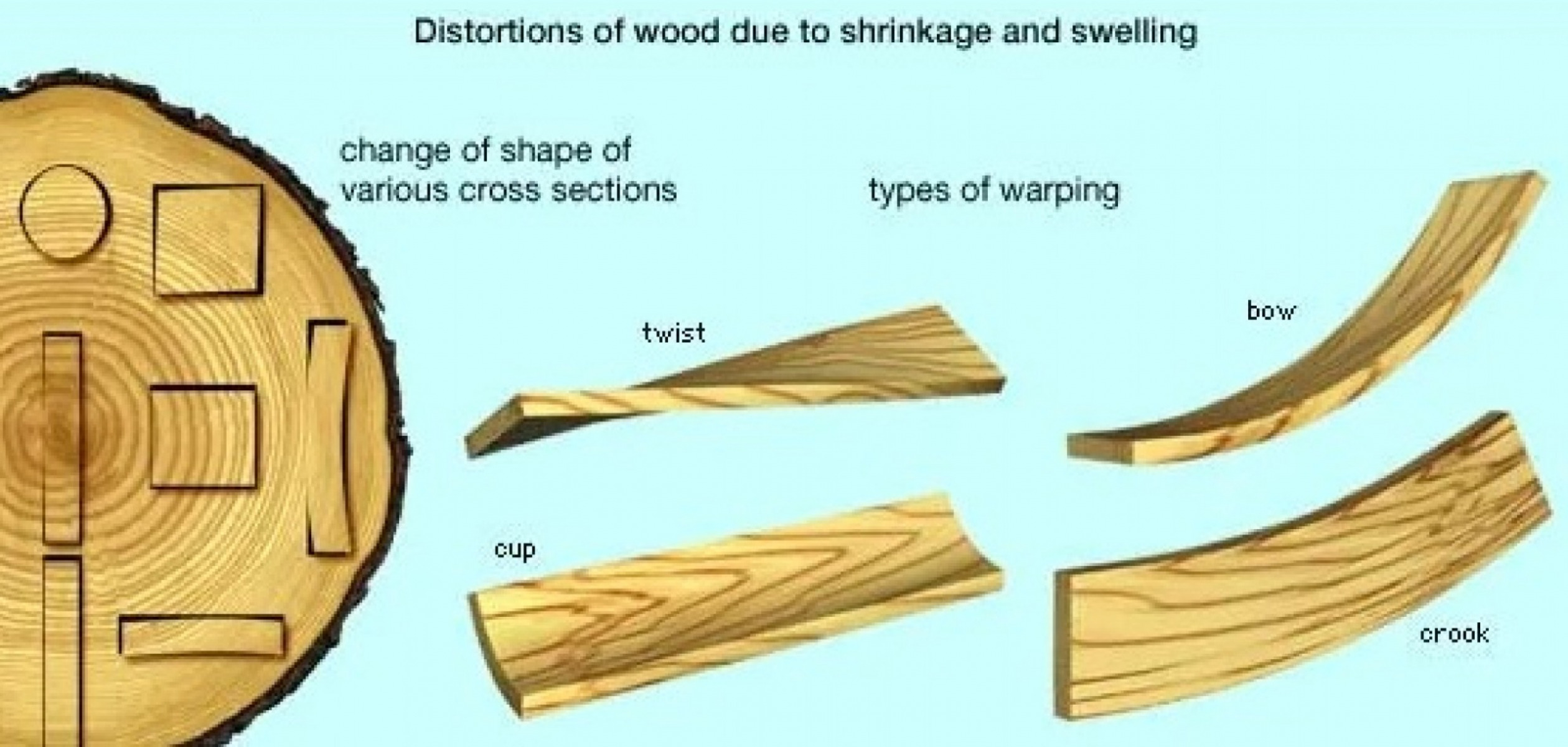
Wood shrinks as it dries and swells again when it takes on moisture. But how much it moves depends heavily on which direction you measure. In the same tree, a flat-sawn board shrinks nearly twice as much across its width as a quarter-sawn board does — and that difference is usually where a window or door board starts to bow, or a stile-and-rail frame starts to twist.
So I gathered shrinkage figures for domestic and imported species, broken down by grain direction. Below, I first unpack the terms you need to read the tables, then follow the tables with calculations you can actually use on the job.
Terms Used in the Tables
Air-dry specific gravity and oven-dry specific gravity — Air-dry specific gravity is a piece's weight, in a naturally air-dried state (moisture content roughly 12–15%), measured against the weight of an equal volume of water. With water set at 1, a pine at 0.47 weighs about 470kg per cubic meter. This is close to the condition wood is actually in around the workshop, so it's the figure used to estimate a door's weight (volume × specific gravity). The value measured fully dry (0% moisture content) is called oven-dry specific gravity, and comes out slightly lower. The domestic-species table below lists both. Generally, the higher the specific gravity, the harder and stronger the wood — but also the harder to plane, and the more it tends to shrink.
Radial shrinkage (quarter-sawn direction) — The shrinkage rate running from pith toward bark, across the growth rings. A quarter-sawn board's width runs in this direction, so this number tells you how much its width will shrink. The ray cells that bind the growth rings together radially resist shrinkage here more than they do in the tangential direction.
Tangential shrinkage (flat-sawn direction) — The shrinkage rate running circumferentially, along the growth rings. A flat-sawn board's width runs in this direction, so it shrinks more than a quarter-sawn board — the largest of the three directions.
Longitudinal shrinkage (length) — Along the length of the tree. The three directions run roughly in a 100 : 60 : 4 ratio of tangential to radial to longitudinal. For domestic red pine, the figures are 9.11 : 4.88 : 0.31, or 100 : 54 : 3.4 — broadly in line with that ratio. Longitudinal shrinkage gets its own section further down.
Total shrinkage — Every shrinkage figure in the tables is a total shrinkage value: the amount a freshly felled log (green wood) shrinks by the time it reaches 0% moisture content, expressed as a percentage of the green dimension. Real window-and-door stock never dries all the way to 0%, so it never shrinks by this full amount — for how much it actually moves, see "On-the-Job Calculations" below, which prorates by the actual change in moisture content. Some sources instead use air-dry shrinkage, based on drying only down to around 15% moisture.
Volumetric shrinkage (imported-species table) — The rate at which volume shrinks when all three directions are combined. Useful for seeing at a glance how dimensionally active a species is overall.
Tangential/Radial ratio (added to the domestic-species table) — Tangential shrinkage divided by radial shrinkage. This isn't in the original source; I calculated it myself. The higher this number, the less evenly a board shrinks as it dries, making it more prone to twisting or cupping toward the face (kiomote) side. I treat anything above 2 as a species that needs particular care in choosing grain orientation.
Swelling (expansion) — The reverse of shrinkage: dry wood expanding as it takes on moisture. The numbers differ slightly because they're measured against the dry dimension as a baseline, but the magnitude is close enough that the shrinkage table can also serve as a rough guide to swelling.
Domestic Species
| Species | Air-dry SG | Oven-dry SG | Radial (quarter-sawn) % | Tangential (flat-sawn) % | Longitudinal % | Tang./Rad. |
| Korean red pine | 0.47 | 0.44 | 4.88 | 9.11 | 0.31 | 1.9 |
| pitch pine | 0.53 | — | 5.77 | 8.53 | — | 1.5 |
| Korean pine | 0.45 | 0.43 | 2.82 | 7.41 | 0.38 | 2.6 |
| Japanese larch | 0.61 | 0.56 | 4.67 | 8.44 | 0.17 | 1.8 |
| fir | 0.40 | — | 5.72 | 12.26 | — | 2.1 |
| sugi (Japanese cedar) | 0.45 | 0.41 | 2.53 | 7.96 | 0.14 | 3.1 |
| hinoki cypress | 0.49 | 0.45 | 3.91 | 6.80 | 0.17 | 1.7 |
| zelkova | 0.69 | 0.64 | 4.25 | 7.76 | 0.66 | 1.8 |
| chestnut | 0.57 | — | 3.46 | 6.40 | — | 1.8 |
| paulownia | 0.24 | — | 1.38 | 4.46 | — | 3.2 |
| sawtooth oak | 0.82 | 0.80 | 5.76 | 11.27 | 0.49 | 2.0 |
| Oriental cork oak | 0.88 | — | 6.85 | 12.20 | — | 1.8 |
| daimyo oak | 0.88 | — | 7.02 | 10.99 | — | 1.6 |
| Oriental white oak | 0.84 | — | 6.22 | 10.81 | — | 1.7 |
| Mongolian oak | 0.82 | 0.78 | 5.97 | 9.48 | 1.04 | 1.6 |
| Korean oak | 0.81 | — | 5.74 | 11.64 | — | 2.0 |
Korea Forest Research Institute, Research Report No.95 (1994). Cited via Gyeonggi-do Forest Environment Research Institute, "Properties and Uses of Wood," Table 1-1-1, and National Forestry Cooperative Federation, Forest Operations Guide Instructor Qualification Study Module — Forest Products Processing (2022), p.18. Oven-dry SG and longitudinal values are available only for the 8 species listed in the study module. Tangential/Radial ratio calculated by the author.
Imported Species
| Species | Radial (quarter-sawn) % | Tangential (flat-sawn) % | Volumetric % |
| Douglas-fir (Coast) | 4.8 | 7.6 | 12.4 |
| Western redcedar | 2.4 | 5.0 | 6.8 |
| Sitka spruce | 4.3 | 7.5 | 11.5 |
| Eastern white pine | 2.1 | 6.1 | 8.2 |
| Western white pine | 4.1 | 7.4 | 11.8 |
| Sugar pine | 2.9 | 5.6 | 7.9 |
| Ponderosa pine | 3.9 | 6.2 | 9.7 |
| Red pine | 3.8 | 7.2 | 11.3 |
| Western larch | 4.5 | 9.1 | 14.0 |
| Port-Orford-cedar | 4.6 | 6.9 | 10.1 |
| White oak | 5.6 | 10.5 | 16.3 |
| Red oak | 4.0 | 8.6 | 13.7 |
| Black walnut | 5.5 | 7.8 | 12.8 |
| Sugar maple (hard maple) | 4.8 | 9.9 | 14.7 |
| Yellow-poplar (tulip) | 4.6 | 8.2 | 12.7 |
| Black cherry | 3.7 | 7.1 | 11.5 |
| Teak | 2.5 | 5.8 | 7.0 |
| Mahogany (true) | 3.0 | 4.1 | 7.8 |
| Lauan (red) | 4.6 | 8.5 | 14.3 |
| Meranti (white) | 3.0 | 6.6 | 7.7 |
USDA Forest Products Laboratory, Wood Handbook (2021), Ch.4, Tables 4-3 & 4-4.
How Quarter-Sawn and Flat-Sawn Boards Differ
How a board behaves depends heavily on how it was cut from the log, even from the same tree. A domestic textbook lays it out this way:
| Property | Quarter-sawn (radial face) | Flat-sawn (tangential/figured face) |
| Warping | slight | severe |
| Width shrinkage | slight | severe |
| Thickness shrinkage | severe | slight |
| Surface checking while drying | slight | severe |
| Drying speed | slow | fast |
| Uniformity | even | uneven |
National Forestry Cooperative Federation, "Forest Products Processing" study module (2022), p.15.
The thickness figures are worth noting in particular. A quarter-sawn board shrinks less in width but more in thickness — because its thickness direction is actually the tangential direction. The Hokkaido Forest Products Research Institute found exactly the same thing when they re-sawed oak flooring stock and measured it: width shrank 7.0–8.2% for flat-sawn boards versus 2.4–3.8% for quarter-sawn, while thickness shrank the other way — 2.9–5.1% for flat-sawn versus 5.9–7.3% for quarter-sawn. Cupping across the width was more than twice as severe in flat-sawn boards as in quarter-sawn.
Carried over to windows and doors: a wide panel, like a raised panel or a plank door, gapes and bows less if it's quarter-sawn. In exchange, when you fit a quarter-sawn panel into a groove, it's worth budgeting for a bit more loss in thickness.
Longitudinal Shrinkage
Longitudinal shrinkage is where domestic and American figures diverge noticeably.
As the table above shows, domestic species each have their own value — conifers range from 0.14% (sugi) to 0.38% (Korean pine), hardwoods from 0.49% (sawtooth oak) to 1.04% (Mongolian oak). The American Wood Handbook, by contrast, simply states that "most species run 0.1–0.2%" and doesn't break the figure out by species. Domestic red pine and Korean pine come in at roughly double the American figure. This may come down to differences in test conditions — where the samples were taken, how much near-pith wood was mixed in — but without the original source material I couldn't confirm the reason. If you're working in domestic species, it seems safer to use the domestic figures as your baseline.
Either way, there are specific cases where longitudinal movement becomes significant on its own.
| Case | Total shrinkage (green → oven-dry) |
| Juvenile wood near the pith | up to about 2% |
| Reaction wood (compression wood in conifers, tension wood in hardwoods) | up to about 2%, sometimes over 3% in a bowed tree |
| Cross grain (grain running off the length) | greater than normal wood |
Wood Handbook (2021), Ch.4; Wood Korea News (2012).
- Stock cut near the pith: the juvenile wood at a tree's center also shrinks significantly in length. Domestic textbooks note that wood near the pith, with more knots and immature wood, is weaker, and recommend routing it toward larger-section stock or lower-grade work.
- Reaction wood: a tree that grew leaning or curved develops reaction wood on one side. Conifers (pine, Korean pine, sugi, etc.) form compression wood below the lean, or on the downhill face if the tree grew on a slope. The 1904 Japanese carpenter's manual Nihon Kaoku Kozo notes that a tree's "back" carries more ate — and that ate is exactly this compression wood. That book defines the downhill face as the "back," which means a carpenter's rule of thumb and modern wood science are pointing at the same spot.
- Cross-grain stock: wood cut so the grain runs off the length also moves more along its length.
On-the-Job Calculations
A rough way to estimate shrinkage per 1% change in moisture content is to divide the total shrinkage figure by 28. This assumes a fiber saturation point of 28–30%, so it isn't exact, but it's close enough to get a feel for the numbers.
Board width — a 300mm-wide pine board drying from 15% to 8% moisture content (a 7-point change)
- Flat-sawn: 9.11 ÷ 28 × 7 ≈ 2.3% → shrinks about 6.8mm.
- Quarter-sawn: 4.88 ÷ 28 × 7 ≈ 1.2% → shrinks about 3.7mm.
Cutting quarter-sawn roughly halves the movement. Species with a high tangential/radial ratio — sugi (3.1), paulownia (3.2), Korean pine (2.6) — show an even wider gap between grain directions, which also makes them more prone to cupping toward the face as they dry.
Member length — an 1,800mm stile, under the same conditions
- Red pine, 0.31%: 0.31 ÷ 28 × 7 ≈ 0.08% → about 1.4mm
- Korean pine, 0.38%: 0.38 ÷ 28 × 7 ≈ 0.10% → about 1.7mm
- Reaction wood, 2%: 2 ÷ 28 × 7 = 0.5% → about 9mm
With normal wood, the movement comes to under 2mm. With reaction wood mixed in, a single stile can shrink almost 9mm — and if that happens on just one stile of a frame, the door twists. This is the number behind the jobsite rule of thumb that says not to use bowed timber or wood from near the pith for long members like stiles or lintels.
How much extra to allow when re-sawing — stock is cut oversize from the start to allow for the loss expected from drying and planing. A domestic textbook gives these examples:
| Finished size (mm) | 15 | 18 | 21 | 24 | 30 | 45 | 60 | 90 | 120 | 180 | 240 | 300 |
| Sawn size (mm) | 16.5 | 20.0 | 23.0 | 26.5 | 33.0 | 49.0 | 65.5 | 97.5 | 130.0 | 195.5 | 259.5 | 324.5 |
Excerpted from National Forestry Cooperative Federation, "Forest Products Processing" study module (2022), p.17.
In other words, thinner stock needs roughly 10% extra, thicker stock roughly 8%. Worth keeping in mind as a baseline when ordering window-and-door stock from the sawmill.
Sources
- 임업연구원, 연구자료 제95호, 1994. 경기도 산림환경연구소, 「제1장 목재의 성질과 용도」 표 1-1-1 「국산재의 목재성질」(37~38쪽)에서 재인용. https://forest.gg.go.kr/wp-content/uploads/sites/6/pdf/sanrim4.pdf
- 산림조합중앙회, 『2022년 산림경영지도원 임용전형 학습모듈 — 임산가공(기본서)』, 2022, 15~20쪽. https://nfcf.scout.co.kr/img/attachfile_1001_8.pdf
- USDA Forest Products Laboratory, Wood Handbook (FPL-GTR-282), 2021, 4장. https://www.fpl.fs.usda.gov/documnts/fplgtr/fplgtr282/chapter_04_fpl_gtr282.pdf
- 北海道立林産試験場, 小西千代治 외, 「フローリング原板の寸法の検討」. https://www.hro.or.jp/upload/11398/08117022001.pdf
- 한국목재신문, 「목재의 수축과 팽윤」, 2004. https://www.woodkorea.co.kr/news/articleView.html?idxno=4057
- 한국목재신문, 윤형운, 「[목재과학카페6] 수분이 목제품에 미치는 영향 ⑥」, 2012. https://www.woodkorea.co.kr/news/articleView.html?idxno=16940
- 斎藤兵次郎, 『日本家屋構造』, 信友堂, 1904. 상권 「緒論」. https://dl.ndl.go.jp/pid/846328
- 2026.10.10 고침: 처음 글에는 섬유방향 수축률을 "수종별 값이 없고 정상재는 0.1~0.2%"라고 적었습니다. 국산재는 수종별 값이 있고 미국 자료보다 크다는 것을 확인해 바로잡고, 국산재 표에 전건비중과 섬유방향 값을 넣었습니다. 곧은결·널결 판 비교와 제재 여유치도 함께 보탰습니다.
You are free to quote and excerpt posts and records from the Workgroup Pyeongmok blog, as long as you credit the source (pyeongmok.com).
If you spot an error or have any thoughts on this post, please email us at .
Browse the pattern designs at Workgroup Pyeongmok
Go to the Collection