
Finishing & Maintenance | What to Apply, and When to Redo It
This series · The Changho Glossary · No. 16 (16 episodes total) Ongoing
"Sorting out the names and joinery of traditional changho, one at a time."
- No. 1 Jeongja-sal | A Changho Joined into the Character 井
- No. 2 Se-sal (細살) | A Changho Set with Fine Slats, Packed Close
- No. 3 Bit-sal | A Changho Joined with Slats Set on the Diagonal
- No. 4 Aja-sal | A Pattern With No Good Meaning
- No. 5 Wanja-sal | A Pattern Overflowing with Meaning
- No. 6 Sutdae-sal | A Changho Joined with Broken Slats
- No. 7 Semo-sotgeul-sal | A Changho Where the Cells Come Out as Triangles
- No. 8 Yukmo-sotgeul-sal | A Changho Where the Cells Come Out as Hexagons
- No. 9 Gyeokja-bit-sal | A Changho Layering Diagonal Lattice Over a Grid
- No. 10 Gwigap-sal | Tenon or Notch?
- No. 11 Yongja-sal | A Jeongja-sal Scaled Up
- No. 12 Changho Hung in Layers | Ssangchang, Yeongchang, Heukchang, Gapchang
- No. 13 Changho Built into the Wall | Bongchang, Salchang, Gwangchang, Deulchang
- No. 14 Small Changho | Baraji, Nukkup, Changgyeong
- No. 15 Slat Thickness | The Starting Point for Every Dimension
- No. 16 Finishing & Maintenance | What to Apply, and When to Redo It
Originally written in Korean and translated into English with the help of AI. Read the original
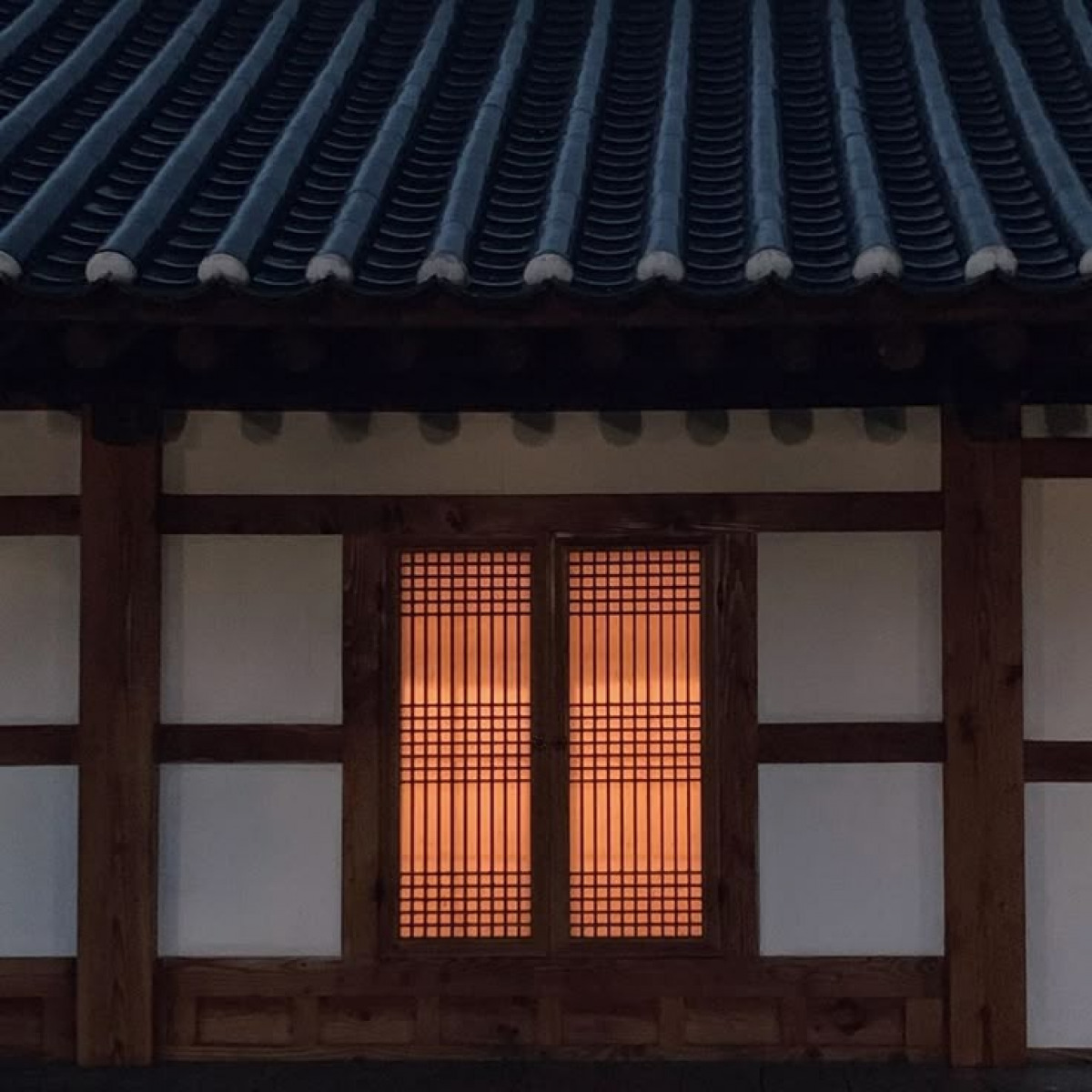
Our windows and doors have the paper pasted on the inside face. That leaves the slats and stile-and-rail frame exposed outdoors, taking direct sun and rain. That alone puts them on different footing from a door like a shoji that stands entirely indoors — starting with how you even choose a finish.
How Wood Left Outdoors Breaks Down
UV in sunlight breaks down the lignin in wood. Lignin is what binds cell to cell, so once it breaks down the surface turns chalky. Rain washes the broken-down material away, mold settles into its place, and within about half a year the wood has turned grey.
Fortunately, this kind of breakdown happens only at the surface. UV is said to penetrate only about 75µm into wood, visible light about 200µm. Leave checking aside, and the damage stays within the outer 1mm. Even bare softwood left to the weather with nothing applied erodes at only around 6mm per century. That's why a door gone grey still turns out sound underneath once you run a plane over it.
Four Branches of Finishing
The first is applying nothing at all. Plane it and leave it. Interior joinery in Japan is often left this way, and when it yellows with age the fix is to wash it rather than repaint it — a method called aku-arai, "lye washing." Lye is an alkaline water made by steeping and straining ash from burned straw or wood; it used to be used for laundering and cutting grease. These days, it seems, the name often survives while the actual work is done with a dedicated commercial cleaner. Left outdoors, the wood turns grey and slowly erodes — but at least there's no film to peel.
The second is a penetrating oil. Raw perilla oil, or the egoma (perilla) oil used in Japan, is rubbed in by hand. It wets the wood, deepening the color a shade and shedding a little more water. But it blocks almost no UV. With no film, there's nothing to peel, either — once it fades, you just rub more in. The trade-off is that you have to apply it often. The USDA Forest Products Laboratory (FPL) puts this kind of finish's outdoor service life at 1–2 years initially, 2–4 years between recoats. It's also vulnerable to mold: the same source notes that drying oils serve as a food source for mold, and domestic testing found raw perilla oil did almost nothing to prevent it (a 4-week mold-resistance rate of 4.10%).
The third is a clear, film-forming finish. This covers boiled oils like myeongyu, tung oil (dongyu), varnish, polyurethane, and lacquer. These shed water well, but on a surface that gets direct sun, the film will eventually lift.
The fourth is a pigmented finish — tinted oils, semi-transparent stains, paint, anything that lays down color. The pigment blocks light, so these last far longer than clear finishes, but at the cost of obscuring the grain, partly or entirely.
Why Clear Films Lift
On the jobsite you often hear "an oiled film lifts in the sun." That's true — but it isn't the film that fails first. It's the wood underneath it.
A clear film doesn't block all UV and visible light. Light passes through it, reaches the wood surface underneath, and breaks down the lignin there, degrading the wood. That very layer the film was bonded to weakens, and the film loses its grip — less the film itself shattering than the bond beneath it giving way. Meanwhile the film itself grows brittle under sunlight and more prone to cracking. It can't keep pace with the wood as it swells and shrinks, so it cracks, and water gets in through the cracks. In the end a soft film lifts and peels; a hard one flakes off in pieces.
USDA literature notes that varnish tends to fail first over earlywood. Hokkaido's Forest Products Research Institute recorded clear coatings turning grey starting from cracks, with mold growing between the film and the wood. In test panels left outdoors for three years, the film still looked sound on the surface while the latewood tissue underneath had already begun to crack.
Once a film has lifted, it's also awkward to repair. Peeled and still-bonded patches sit side by side in a mottled pattern, which makes spot repair difficult; usually you have to strip the whole thing and start over. This is the sharpest contrast with a penetrating oil.
How Long Does It Last?
I've put together figures from the USDA Forest Products Laboratory (Williams 1999) and a 2022 presentation by Atsushi Kataoka of Japan's Forestry and Forest Products Research Institute.
| Time outdoors before a finish needs recoating | |
| Clear varnish / polyurethane | 1–2 years (within 2 in most temperate climates, within 1 in the tropics) |
| Water repellents / penetrating oils | 1–2 years initially, 2–4 years between recoats |
| Semi-transparent stain | 2–4 years on smooth surfaces, 5–8 on rough |
| Semi-transparent penetrating protective coating (Japan) | 2–3 years, 4–6 from the second coat on |
| Semi-transparent film-forming coating (Japan) | 3–5 years |
| Paint / opaque finishes | 4–10 years |
÷ The Japanese figures are transcribed from a table in a lecture handout, so the original source still needs to be verified.
Both the American and Japanese data agree that clear films are the shortest-lived option. FPL goes so far as to say it doesn't recommend varnish for exterior wood at all, and Japan's building-standard specification for construction work (JASS 18) apparently has no provision at all for clear exterior wood coatings. Hokkaido's Forest Products Research Institute likewise advises reserving clear finishes for spots that get neither direct sun nor rain. A water-based polyurethane sign kept out of the rain, for instance, reportedly developed only minor surface crazing even after 5 years — so where you put a given finish matters nearly as much as which finish it is.
Lacquer Is a Different Story
Lacquer also forms a film, but it fails differently. Rather than peeling, it erodes from the surface inward and takes on a whitish, powdery look. Kyoto City's Industrial Technology Research Institute tracked lacquered metal fittings left outdoors for ten years; where exposure to sunlight was strong, the black-lacquer film had lost 243µm of thickness.
Because of this, the original application was built around a film over 400µm thick from the start, with a maintenance routine of wiping it down with water every ten days. In testing of tsugaru-nuri lacquerware in Aomori Prefecture, a surface exposed to a year of direct sunlight had powdered away entirely, leading researchers to conclude that lacquer film simply isn't suited to outdoor use. Domestic testing found the same: raw-lacquer film exposed to UV developed pitting and cracks on the surface, and after 600 hours its strength had dropped sharply.
As a finish for interior faces or indoor sliding doors, lacquer is excellent and long-lasting — but it isn't suited to slats that take direct sun outdoors.
What the Korean Record Shows
Myeongyu comes up often as a finishing oil in Joseon-era architecture. It's made by boiling raw perilla oil together with pyrolusite (manganese dioxide), litharge (lead oxide), and alum, and it appears in nearly every uigwe (royal protocol record); one entry records 400 mal of myeongyu used for palace finishing work in the 7th year of King Taejo's reign. Raw perilla oil takes a long time to cure, but myeongyu cures in roughly 12 hours, and in mold-resistance testing it blocked 87.67% of mold growth when applied by soaking. There's also research suggesting that the dongyu (tung oil, literally "paulownia oil") mentioned in the uigwe actually refers to boiled perilla oil or myeongyu itself — the scholar Seo Yu-gu reportedly wrote that "since we don't know how to cultivate the tung tree, we call boiled perilla oil 'dongyu' instead."
Unfortunately, I haven't been able to find published test data on how well myeongyu holds up in sunlight, or whether it lifts. As a film-forming oil, it seems hard to avoid the same fate as other clear films eventually — but for now that's only a guess. In current heritage restoration work, raw perilla oil is what's used as the finishing material for dancheong (traditional painted ornamentation).
Surveys of Japanese folk houses tell a similar story. In interior lattice windows and the boxes storing storm shutters, researchers found oil that had been boiled with a lead drier (presumed to be tung oil); but on exterior woodwork, weathering was so severe that it was impossible to tell what, if anything, had been applied. Exterior finishing, in other words, has left behind neither record nor trace.
Maintenance
The first priority is not missing the window for recoating. Hokkaido's Forest Products Research Institute holds that the best time to recoat is right as degradation is just beginning. Once a film starts lifting, you have to strip it all; catch it before that, and a thin recoat is enough. In testing by Japan's Forestry and Forest Products Research Institute, the point at which water-repellency dropped below 80% of its original value was used as the trigger for recoating.
Rounding over the edges also helps a finish last. When Hokkaido's Forest Products Research Institute left 11 film-forming coatings outdoors for four years, square edges and 45° chamfers cracked and began peeling within a year, while rounded-over edges degraded far less. Even with the same coating, film thickness came out to 257µm on a flat face versus only 97µm on a square edge — the film simply runs thinner at corners. The rounding on a slat or stile-and-rail edge, in other words, isn't just about shape; it's tied directly to how long the finish survives.
Color faded by sunlight comes back with a plane, because the degradation stays at the surface. By contrast, black staining from contact with iron, or discoloration from mold, runs deeper and doesn't come out as easily. It's best to simply keep metal from touching wet wood in the first place.
Even within the same house, different windows and doors weather at different rates, because how deep the eaves run, which direction a window faces, and whether it has storm shutters all change how much sun and rain it actually takes. One Japanese source notes that a south-facing vertical surface erodes at only about half the rate of a surface tilted 45° toward the south.
Sources
- R. Sam Williams, "Finishing of Wood," Wood Handbook, FPL-GTR-113, 미국 농무부 산림제품연구소, 1999, 15장 (pp.15-7, 15-14~15-20).
- D. L. Cassens & W. C. Feist, Finishing Wood Exteriors, 미국 농무부 Agriculture Handbook 647, 1986. https://www.fpl.fs.usda.gov/documnts/usda/ah647.pdf
- P. D. Evans 외, "The search for durable exterior clear coatings for wood," Coatings 5(4): 830–864, 2015. https://www.mdpi.com/2079-6412/5/4/830
- A. Cogulet, P. Blanchet & V. Landry, BioResources 13(1): 2116–2138, 2018. (Hon & Ifju 1978의 75µm·200µm 인용)
- P. F. Laleicke & M. A. Hubbe, "Outdoor wood finishing: A review," BioResources 20(3): 7903–7982, 2025.
- 가타오카 아쓰시, 「목재의 내후성과 도장 등에 의한 표면 보호에 대하여」, 에히메현 CLT 세미나 자료, 2022. (원제: 片岡厚, 「木材の耐候性と塗装等による表面保護について」) https://ehimeclt.com/web/wp-content/uploads/2022/10/R401.pdf
- 이사지 신이치, 「목제 새시의 도장」(2013.8), 「만재부의 도막은 왜 잘 벗겨지는가」(2019.4), 「도막 열화에 미치는 모따기 가공의 효과」(2024.1), 『임산시험장 소식』, 홋카이도립종합연구기구 임산시험장. (원제: 伊佐治信一, 「木製サッシの塗装」, 「晩材部の塗膜はなぜはがれやすいのか?」, 「塗膜の劣化に及ぼす面取り加工の効果」, 『林産試だより』)
- 「옥외에서의 투명 도장 마감 이용」, 『임산시험장 소식』 2016.11. (원제: 「屋外における透明塗装仕上げの利用」, 『林産試だより』)
- 이시카와 아쓰코 외, 「목재 보호 도료의 내후 성능 평가: 시판 도료 43종의 옥외 폭로 4년」, 『목재보존』 42(2): 72–80, 2016. (원제: 石川敦子 外, 「木材保護塗料の耐候性能評価―市販塗料43種類の屋外暴露4年間」, 『木材保存』) https://www.jstage.jst.go.jp/article/jwpa/42/2/42_72/_article/-char/ja/
- 오야부 야스시·사토 다카히코, 「옥외용 색칠 옻칠 장식 쇠붙이의 10년간 자연 폭로 결과를 생각한다」, 교토시 산업기술연구소 연구보고 No.10, 2020. (원제: 大藪泰·佐藤貴彦, 「屋外用色漆塗り錺金具の10年間の天然曝露結果を考える」)
- 쓰가루 칠 옥외 시험 보고(제4보), 아오모리현 산업기술센터. (저자: 小松勇 외)
- 안선아·김은경·장성윤, 「옻과 옻에 아교를 배합한 천연접착제의 자외선에 의한 노화 특성 연구」, 『보존과학회지』 32(4): 501–510, 2016.
- 윤새민 외, 「전통 마감제인 명유의 방미효력 평가」, 『보존과학회지』 36(6): 505–510, 2020.
- 장영주·류성룡, 「조선시대 동유(桐油) 사용의 진위」, 『건축역사연구』 32(5): 107–117, 2023.
- 기타노 노부히코 외, 「민가 건조물의 전통 도장 재료 조사와 수리」, 『보존과학』 52: 227–240, 2013. (원제: 北野信彦 外, 「民家建造物における伝統的な塗装材料の調査と修理」, 『保存科学』)
- R. S. Williams, M. T. Knaebe, P. G. Sotos & W. C. Feist, "Erosion Rates of Wood During Natural Weathering. Part I. Effects of Grain Angle and Surface Texture," Wood and Fiber Science 33(1): 31-42, 2001. (연 33~101µm 침식 측정 — "100년에 6mm 안팎" 침식 속도 수치의 근거)
You are free to quote and excerpt posts and records from the Workgroup Pyeongmok blog, as long as you credit the source (pyeongmok.com).
If you spot an error or have any thoughts on this post, please email us at .
Browse the pattern designs at Workgroup Pyeongmok
Go to the Collection